Cloud Gaming 45 Percent Holiday Surge And What It Means For Gamers In 2026
Cloud Gaming 45% Holiday Surge And What It Means For Gamers In 2026
Updated: 18 December 2025
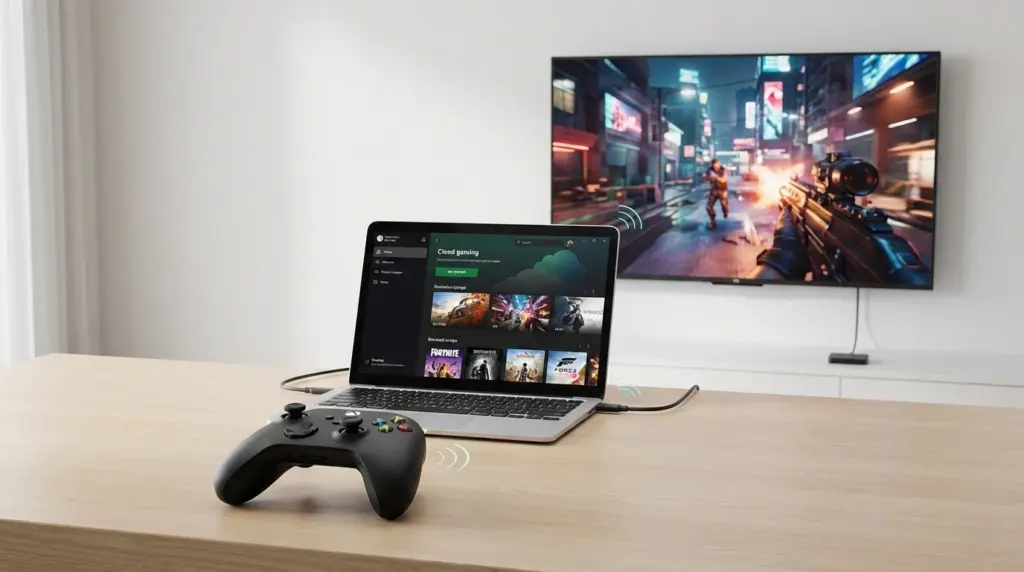
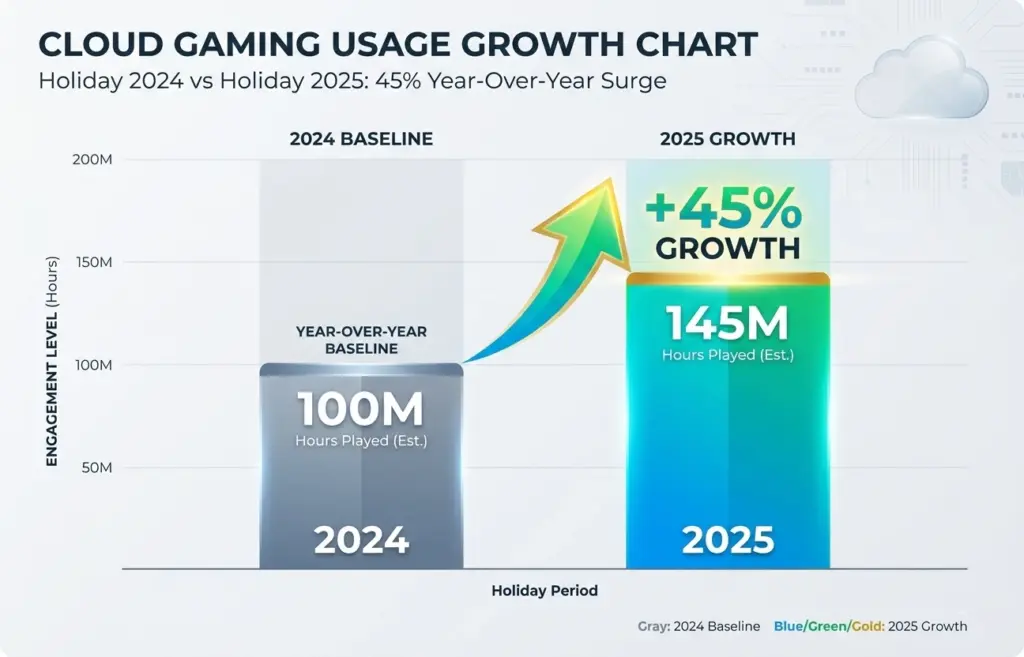
Cloud gaming usage jumped about 45% over the recent holiday season on Xbox Game Pass, showing that streaming games from the cloud is no longer a niche experiment but a normal way to play for millions of people.
Microsoft has said that Game Pass subscribers spent around 45% more hours playing via cloud than during the previous holiday period, while the overall Xbox ecosystem passed 180 million monthly active users. At the same time, Nvidia, Sony and Amazon are all pushing their own streaming services to more devices, including phones, laptops and smart TVs.
This guide explains what cloud gaming is, why that 45% surge matters, how things look in India, the US and the UK, what internet speeds you really need, and whether you should treat it as a main platform or just a useful extra option in 2026.
TL;DR – What A 45% Cloud Gaming Surge Actually Means
Cloud gaming in 2025 and 2026 means games running on remote servers while your device simply streams the video and sends your inputs back over the internet.
- 45% usage jump: Xbox says Game Pass subscribers spent about 45% more time playing through the cloud this holiday than last year, showing that many players now treat streaming as a normal way to access games.
- Big four services: Cloud gaming services like Xbox Cloud Gaming, Nvidia GeForce NOW, PlayStation cloud streaming and Amazon Luna now reach phones, laptops, tablets, smart TVs and even handhelds.
- Better tech: Newer RTX powered servers, faster broadband and 5G have lowered latency and boosted image quality compared with early cloud platforms.
- Still not perfect: Input lag, data caps and patchy coverage mean it is not ready to replace consoles and PCs for everyone, especially competitive players.
Short answer: cloud gaming growth in 2025 and 2026 shows that streaming is becoming a mainstream access option, but local hardware still matters a lot for offline play and low latency shooters.
What Is Cloud Gaming In 2025 And 2026?
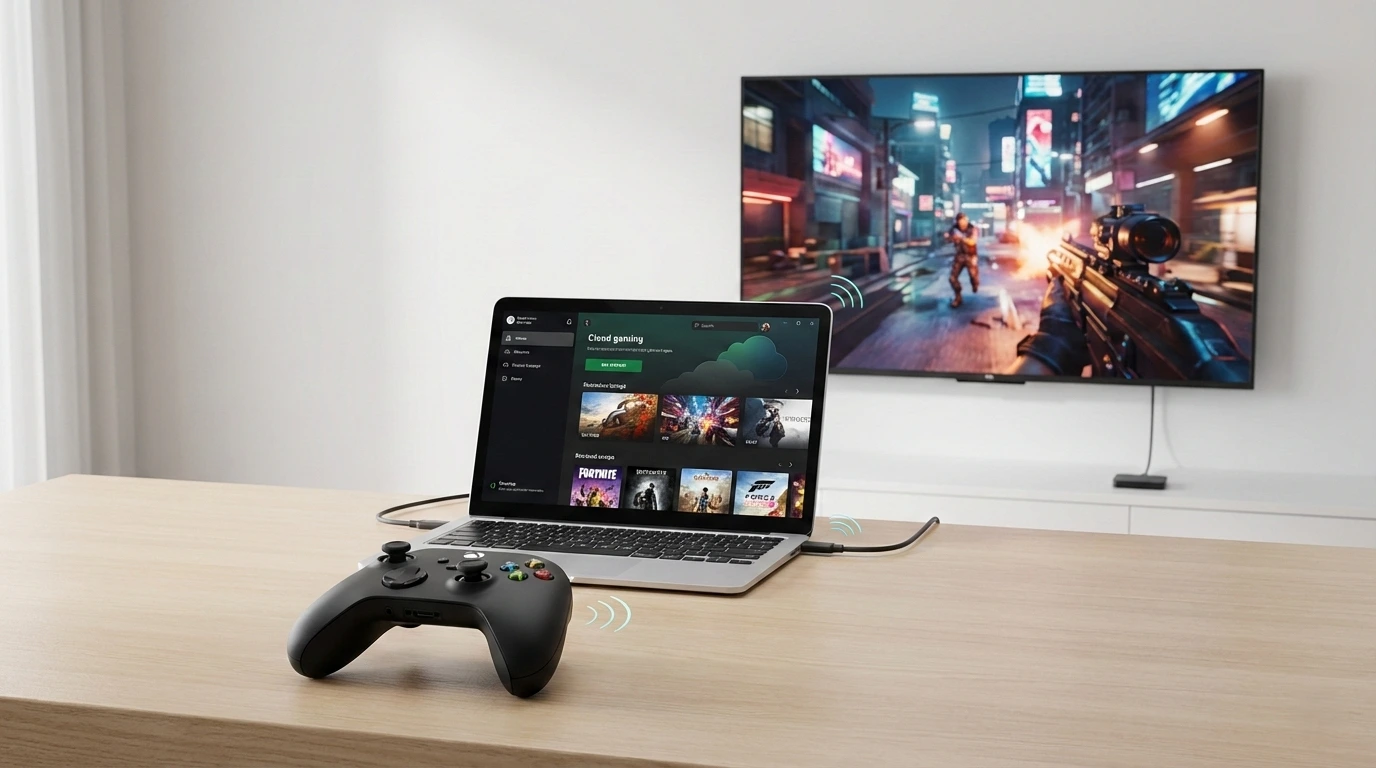
Cloud gaming in 2025 and 2026 means playing games that run on powerful remote servers while your phone, laptop, tablet or TV simply streams the video feed and sends your button presses over the internet.
In a traditional setup, your console or gaming PC renders everything. With this streaming model, the data center does the heavy work, so even a modest device can display visually demanding titles as long as the connection is good enough.
This is different from:
- Local console or PC play: The game runs on your own hardware, giving minimal input delay, full mod support on PC and offline play.
- Remote play from your own console: The game still runs on your console at home while you stream it across your home network to a handheld or phone.
Key advantages of this style of game streaming:
- No need to buy a high end GPU or newest console to see modern visuals.
- Instant access to supported titles without long downloads and patches.
- Easy to hop between devices with the same save file.
Key drawbacks:
- You need stable, fairly fast internet with low ping.
- Picture quality drops when your network is congested.
- You cannot play offline and heavy use can eat through data caps.
The 45% Cloud Gaming Surge – Where The Growth Is Coming From
This 45% jump in streamed play time comes from several major platforms growing at the same time, not just one company.
Xbox Cloud Gaming And Game Pass
On Xbox, cloud play is bundled with Game Pass Ultimate. Microsoft has said that, over the latest holiday period, hours played through Game Pass streaming rose by roughly 45% year over year, and that the wider Xbox ecosystem now has well over 100 million active players each month.
Game Pass Ultimate members can stream hundreds of supported titles to phones, tablets, PCs and some smart TVs. Expansion to more countries, including India, plus better controller and touch support on mobile, has helped this style of play feel more routine instead of a tech demo.
You can learn more about the current offer on the official Xbox Cloud Gaming page:
https://www.xbox.com/cloud-gaming.
Nvidia GeForce NOW
Nvidia has upgraded GeForce NOW with new high end RTX powered servers and a library of thousands of streamable games. Ultimate tier members can stream at up to 4K with high frame rates, bringing the experience quite close to using a powerful gaming PC if your internet connection is fast and stable.
Instead of selling games, Nvidia lets you stream titles you already own from stores like Steam and Epic where supported. That makes it attractive for PC players who want to tap into game streaming without rebuilding their entire library.
Current features and supported games are listed on the official GeForce NOW site:
https://www.nvidia.com/en-us/geforce-now/.
PlayStation Cloud Streaming
Sony includes streaming as part of its PlayStation Plus Premium tier. Subscribers in supported regions can stream hundreds of PS4 and PS5 games, including many big exclusives, to their console or other supported devices.
In 2025 Sony also leaned harder on streaming through its PlayStation Portal handheld, turning it into a true cloud and remote play device for many players who want to keep playing their PS5 library away from the main TV.
Details on supported regions and titles live on Sony’s PlayStation Plus page:
https://www.playstation.com/ps-plus/.
Amazon Luna And Smaller Services
Amazon Luna focuses on simple access and family play. It lets you stream a rotating mix of games on Fire TV, some smart TVs, laptops, phones and tablets, with extra perks for Amazon Prime members.
Luna has also started appearing on select operator and TV boxes, which quietly puts game streaming in front of households that never bought a console. It shows how this tech can slip into living rooms in the same way as streaming video apps.
You can see the current channels and supported devices here:
https://www.amazon.com/luna.
| Service | How it works | Devices | Library style | Typical max quality |
|---|---|---|---|---|
| Xbox Cloud Gaming | Included with Game Pass Ultimate | Xbox, PC, phones, tablets, smart TVs | Game Pass catalog plus a few extras | Up to 1080p or higher on some devices |
| Nvidia GeForce NOW | Streams games you own on PC stores | PC, Mac, phones, tablets, some TVs | Thousands of supported PC titles | Up to 4K with high frame rates on top tiers |
| PlayStation cloud streaming | Part of PlayStation Plus Premium | PS5, PS4 and selected devices | Hundreds of PS4 and PS5 games | Up to 1080p in most regions |
| Amazon Luna | Channels and Prime linked libraries | Fire TV, smart TVs, phones, tablets, PCs | Curated catalog by channel | Up to 1080p at 60 fps |
Put together, these services explain much of the recent cloud gaming growth in 2025 and set the stage for even more usage through 2026 as libraries and device support expand.
Why Cloud Gaming Is Surging Now
Several trends are driving cloud gaming growth in 2025 and 2026 at the same time.
- Expensive hardware: New GPUs and consoles cost a lot, especially in regions like India and the UK. Streaming lets many players enjoy modern visuals without buying high end hardware.
- Better networks: Fiber broadband and 5G networks in big cities now routinely hit speeds that can handle smooth game streaming when latency is low.
- Day one access: More big releases are arriving on subscription and streaming platforms on or near launch day, so there is less friction to trying them.
- Cross device habits: Players are used to watching shows across TV, laptop and phone, and expect games to follow the same pattern.
- Subscription mindset: Monthly access for a large library feels normal in a world of Netflix and Spotify, and these game services plug into that habit.
Put together, these trends explain why cloud gaming growth is spiking around the 2025 holiday season and is likely to stay strong into 2026.
Cloud Gaming In India vs US vs UK (Availability, Speeds And Limits)
Cloud gaming in India, cloud gaming in the US and cloud gaming in the UK all share the same basic idea, but the details feel very different once you look at internet speeds, data caps and which services are available.
Cloud Gaming In The United States
In the US, players have the widest choice of services. Xbox cloud streaming, GeForce NOW, PlayStation Plus Premium streaming and Amazon Luna all operate here, and many homes in big cities have 200 to 1000 Mbps fiber or cable lines.
The main pain points in the US are data caps and rural coverage. Some providers still apply monthly data limits, and high resolution game streaming can use as much data per hour as 4K video. Rural and small town networks may also suffer from higher ping and more jitter, which hurts responsiveness.
Cloud Gaming In The UK
The UK has rapid fiber and 5G rollout in many towns and cities, and supports most of the same services as the US, including Xbox cloud streaming, GeForce NOW and PlayStation streaming. Amazon Luna is more selective but still reachable from browsers and some smart TVs.
For British players, the biggest factors tend to be pricing and library differences between services, plus patchy coverage in rural or coastal areas where fast broadband is still catching up. When the connection is good, though, game streaming can feel very close to local play for slower paced titles.
Cloud Gaming In India
Cloud gaming in India is especially interesting because high end consoles and gaming PCs are costly relative to average income, while mid range Android phones and smart TVs are very common. As 5G and fiber spread through metro areas, more Indian gamers are starting to treat game streaming as a realistic way to try bigger titles.
At the same time, coverage and stability drop sharply outside major cities, and many cheaper mobile plans still have strict data limits. That means a smooth experience is most realistic for players in well connected urban areas who already pay for decent broadband or generous 5G plans.
| Region | Main services | Typical city speeds | Main limits |
|---|---|---|---|
| United States | Xbox, GeForce NOW, PlayStation streaming, Amazon Luna | 200 – 1000 Mbps fiber or cable for many homes | Data caps, peak congestion, rural latency |
| United Kingdom | Xbox, GeForce NOW, PlayStation streaming, some Luna access | Fast fiber and 5G in most towns and cities | Library differences, rural slow spots, pricing |
| India | Growing mix of Xbox streaming, GeForce NOW partners and telco trials | Fast 5G and fiber in metros, slower elsewhere | Coverage outside big cities, data caps on cheaper plans |
Is Cloud Gaming Worth It In 2026? Pros, Cons And Use Cases
Cloud gaming is worth it in 2026 if you already have fast, stable internet and mainly play single player or co op games, but it is still a risky main platform for ranked shooters and fighting games.
Who Game Streaming Works Well For
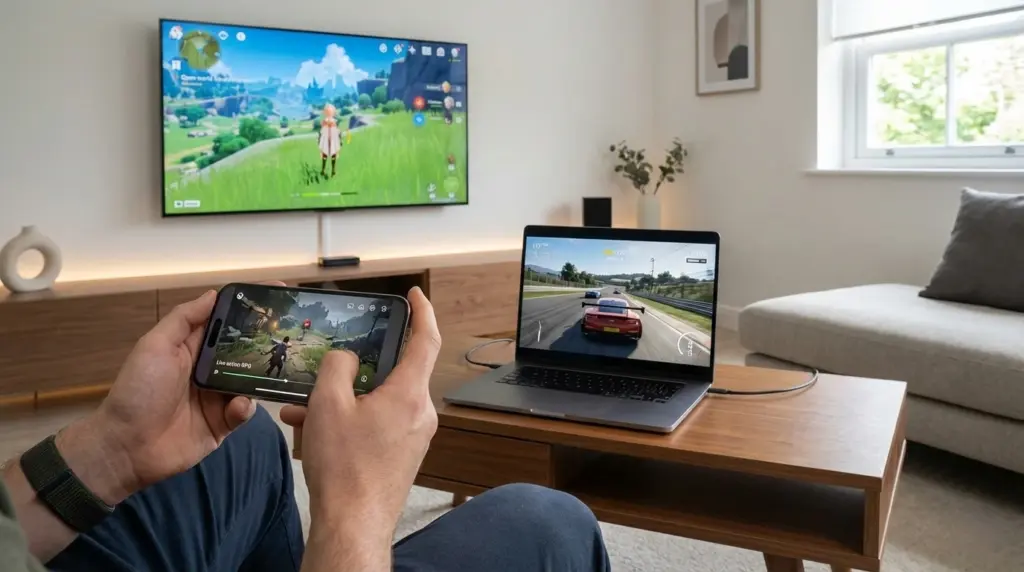
- Play on older devices: People using older laptops or entry level PCs who still want to try recent AAA games.
- Travel often: Players who move between home, work, dorms or hotels and want a portable way to keep playing the same titles.
- Casual and co op focus: Fans of story driven games, RPGs, strategy and co op titles where tiny input delays do not ruin the experience.
- Curious about big launches: Gamers excited for upcoming hits like GTA 6 who would rather sample them through a subscription than buy new hardware on day one. For up to date platform info you can check our GTA 6 release date and platforms guide.
Where Local Hardware Still Wins
- Competitive shooters and fighters: High level play in games like Valorant or fast fighting titles really benefits from the lowest possible latency.
- Unstable or capped internet: If your connection drops often or your ISP has strict monthly caps, heavy streaming may be more frustration than fun.
- Heavy daily play: Players who game many hours every day might be better off owning their hardware if subscription costs pile up.
For many people in India, the US and the UK, the best answer is a hybrid: keep consoles or PCs for the games where latency and ownership matter, and use cloud streaming as a flexible extra way to play on other screens.
What Internet Speed Do You Need For Cloud Gaming?
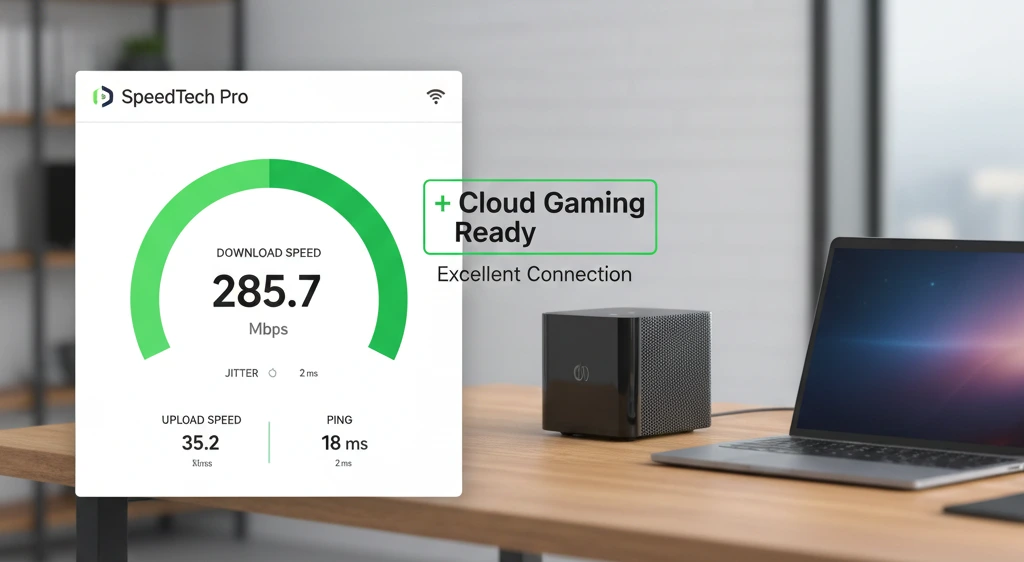
Most cloud gaming services recommend at least 15 Mbps for 720p, around 25 Mbps for 1080p and 40 Mbps or more for 4K, along with low ping and low jitter.
- Basic HD (720p): 10 – 15 Mbps is often listed as the minimum for a reasonably stable stream at 60 frames per second.
- Full HD (1080p): 25 Mbps or higher is a common recommendation from major providers.
- 4K and high frame rates: 40 – 50 Mbps or more is usually advised, especially if you want top picture quality on large TVs.
Latency is just as important. Ideally you want ping under 40 ms to the service, with under 80 ms as a soft upper limit for smooth play. Large spikes in jitter can hurt just as much as slow download speeds.
- Use wired Ethernet or 5 GHz Wi Fi where possible.
- Keep other big downloads and 4K video streams off the network during game sessions.
- Place your router in an open spot, not hidden behind metal or thick walls.
How Cloud Gaming Could Shape Big Releases In 2026
Cloud gaming could quietly change how major releases are launched and discovered over the next year or two.
- Instant trials and demos: Instead of multi gigabyte downloads, a click to play cloud demo lets people test a game in seconds and decide if it is worth installing or buying.
- Day one subscriptions: Big releases that land on streaming services at launch can reach more players on day one, even those on older hardware.
- Wider regional access: In places where consoles are rare but decent broadband exists, game streaming can become the main way people touch high budget titles at all.
On the flip side, players relying only on streaming depend entirely on the life span of each service and subscription. Modding, full ownership and long term preservation still live mostly in the world of local PC and console play.
Cloud Gaming FAQ
What is cloud gaming and how does it work?
Cloud gaming is a way to play video games where the game runs on hardware in a remote data center and streams to your device like live video. Your inputs go back over the internet, and the server sends you updated frames in response, so your phone, laptop or TV does not need powerful graphics hardware.
Does cloud gaming really need 5G?
You do not need 5G specifically, but you do need a fast, reliable connection. Good fiber or cable broadband with low ping is usually enough. 5G is useful if you want to stream games on the move or do not have fixed broadband at home.
Which cloud gaming service is best in India, the US and the UK?
There is no single best choice. In the US and UK, Xbox, GeForce NOW, PlayStation streaming and Luna all compete, and the best fit depends on your library and devices. In India, availability is more limited and networks vary more between cities, so you should test any free trials and see which feels stable on your connection.
Can I use cloud gaming on a smart TV?
Yes. Many modern smart TVs and streaming sticks support official apps for services like Xbox, GeForce NOW and Amazon Luna, or let you access them through a browser. You usually pair a Bluetooth or USB controller to play.
Do cloud gaming services support mods?
Most streaming platforms do not support classic PC style mods because you cannot access the game files on the remote server. Some titles still support in game mod browsers or user generated content, but full modding freedom remains a key advantage of local PC gaming.
Is cloud gaming cheaper than buying a console?
In the short term, cloud gaming can be cheaper because you avoid the upfront cost of a console or gaming PC. Over several years, subscription fees and add ons can add up, so heavy players may still find it more economical to buy hardware and own games outright.
Can I play cloud games with a controller on my phone?
Yes. Most mobile devices support Bluetooth or wired controllers, and major streaming apps are designed to work with Xbox, PlayStation and many third party pads. Some services also offer touch controls, but a physical controller usually feels better.
Does cloud gaming work well for competitive shooters?
For casual shooter matches, good connections can feel surprisingly smooth. For high-level ranked play, the added latency and occasional stutters still make local console or PC gaming the safer choice, especially for reaction-based titles.
Will cloud gaming replace consoles and PCs?
In the near future, cloud gaming is more likely to sit alongside consoles and PCs than replace them. It offers a second way to access games when you are away from your main setup or do not own high-end hardware, while local devices remain important for low latency, mods, and offline play.
Is cloud gaming available in every country?
No. Each provider chooses specific countries and regions to support, and some services still have limited coverage in parts of Asia, Africa, and South America. Even in supported countries, only players with decent broadband or 5G will get a good experience, so it is always wise to try a free test session first.
Cloud gaming usage is up roughly 45% year over year on some major platforms and is still rising, helped by faster networks, better servers, and more flexible subscriptions. For most players in India, the US, and the UK, it makes sense to treat this tech as a handy extra way to play on other screens while keeping consoles or gaming PCs for the titles that demand the very best performance and control.